

Hello! I'm
Your hype girl, sounding board, designer, and friend! I design branding and websites for business owners who want to pave the way in their industry.
Sydney.
brand and web design services
I design brands that release the confidence in you.
made for mothers x dfw
I lead the local DFW chapter for a CEO Mom Community, MFM

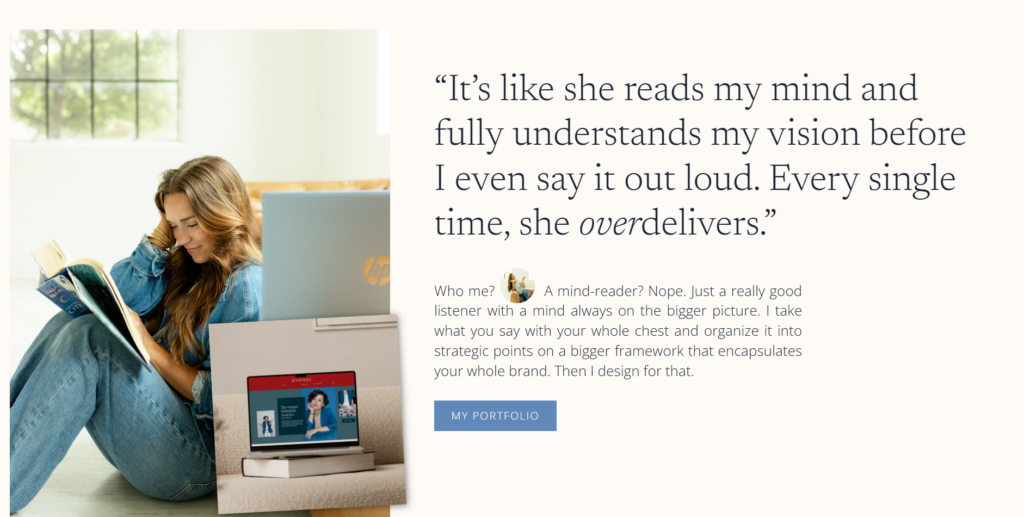
People ask me this all the time. Usually after they’ve seen their website copy or their brand for the first time and they’re kind of blown away that it sounds so much like them.
“How did you know that’s exactly how I talk?” Or “That’s literally what I’ve been trying to say but could never articulate.” Or my personal favorite, “This is so me. How did you do that?”
The answer is simple but it requires work. I asked a lot of questions. I listened. I paid attention. I didn’t assume I knew what you wanted. I asked you to tell me.
And then I asked you again in a different way to make sure I actually understood.
The Problem With Most Designers and Copywriters
Here’s what usually happens. You hire someone. You give them a brief. Maybe a questionnaire. Maybe you have one call. And then they disappear and come back with something they think is good.
Sometimes it is. Sometimes it’s not. Sometimes it sounds nothing like you. Sometimes it looks like every other brand in your industry. Sometimes it’s beautiful but it doesn’t actually sell. Sometimes the copy sounds corporate even though you’re the opposite of corporate.
And when you tell them it’s not quite right, they get defensive. Or they blame you for not being clear enough in the brief. Or they just make small tweaks and call it a day.
That’s not how I work.
How I Actually Get to Know You
Before I ever open design software or write a single word of copy, I’m asking questions. A lot of them. And not the generic ones from a form you fill out.
I want to know who you actually are, not who you think you should be. I want to know what you actually believe about your business. I want to know your story. The real one. The messy one that led you here. Not the sanitized version you tell at networking events.
I want to know who your ideal client is. Not demographically. Not “women ages 25-45 who like yoga.” I want to know what they’re scared of. What they’re tired of. What they actually need from someone like you. What they would say about you if you asked them why they hired you.
I want to know how you talk. Not in a formal setting. How do you actually talk? What words do you use? What phrases come naturally to you? What do you say to friends that you never say in business? What’s your sense of humor like? Are you sarcastic? Self-deprecating? Straightforward? Do you curse? Do you use pop culture references?
I want to know what you’re worried about. What if people don’t take you seriously? What if they think you’re too young or too old or not experienced enough? What if they leave because your competitor looks fancier? What if they don’t understand what you do?
I want to know what you’re proud of. What do you want people to know about your work? What do you never compromise on? What makes you different even if you think it’s not that different?
This is the stuff that matters.
How I Get This Information
I do this through questionnaires, sure. But questionnaires are just the start. Then I ask follow-up questions. Then I look at how you answer. Because sometimes what you write in a form isn’t how you actually talk.
I look at your current messaging. What are you already saying? What words keep coming up? What phrases do you use over and over? That tells me how you naturally communicate.
If you want a sneak peek into this process, I have a free mini workshop you can do to get started on your voice clarification.
I look at your Instagram. How do you show up there? What do you talk about? What’s your tone? Are you sharing behind-the-scenes or are you more polished? Are you personal or professional? Are you funny or serious?
I look at your reviews and testimonials. What are your clients actually saying about you? What words do they use? What problems did you solve for them? What do they value most about working with you? This is gold. Your clients know how to talk about you better than you do sometimes.
I ask you about your audience. Tell me about a recent client you loved working with. What was their life like? What were they struggling with? What did they need from you? How did they feel after working with you? Paint me a picture of that person.
I ask you about your competitors. Not to copy them. But to understand what they’re doing that you’re not, and what you’re doing that they’re not. What makes you choose to work with you instead of them?
I ask you about your fears. Your goals. Your vision. Your non-negotiables. The things that matter to you that maybe don’t matter to other people in your industry.
And then I listen. Not just to your words but to how you say them. Not just to the information but to what you care about and what gets you animated.
How I Turn That Into Copy
Once I understand you and your audience, I write copy that sounds like you speaking to them.
That means I’m not writing “solutions-oriented branding for forward-thinking entrepreneurs.” I’m writing the way you actually talk to people. If you’re warm and personal, the copy is warm and personal. If you’re direct and no-nonsense, the copy is direct and no-nonsense. If you use humor, the copy uses humor. If you’re storytelling, the copy tells stories.
But it’s not just about sounding like you. It’s about speaking to the actual fears and desires of your audience. It’s about addressing the questions they’re actually asking. It’s about proving to them that you understand them and can help them.
Good copy does both. It sounds like you and it speaks to them. When those two things come together, that’s when people feel seen. That’s when they reach out.
How I Turn That Into Design
The same thing happens with design. I’m not designing what I think looks cool. I’m designing for your specific audience, in your specific voice, to prove your specific message.
If your copy is warm and personal and you serve overwhelmed moms, your design shouldn’t look sleek and corporate. It should feel approachable. It should feel like someone who gets it designed it. It should feel like you.
If your copy is elevated and luxury and you serve high-end clients, your design should feel premium. It should feel intentional. It should feel like someone who knows what they’re doing designed it.
The colors, the fonts, the layout, the imagery, the white space, all of it should work together to reinforce the message you’re putting out there. All of it should feel consistent with how you show up in the world.
And all of it should speak to your specific audience. Not everyone. Your people.
Why This Matters
Here’s why this is important. When you hire someone who just designs what they like or writes copy in their own voice, you end up with something that doesn’t feel like you. Something that doesn’t actually connect with your people. Something that feels like it could be anyone’s.
But when someone takes the time to really understand you and your audience, something shifts. Your ideal clients feel like you picked them out and said “This is for you.” They feel seen. They feel understood. And when people feel that way, they reach out.
That’s the whole point.
The Process Feels Long But It’s Worth It
I’ll be honest with you. This process takes time. The questionnaire. The follow-up questions. The deep work to understand who you are and who your audience is. It’s not fast.
But it’s the difference between a website that feels generic and a website that feels like you. It’s the difference between copy that could be anyone’s and copy that’s undeniably yours. It’s the difference between design that looks nice and design that actually works because it’s aligned with everything else.
I could skip this part and just design something pretty and move on. But then you’d have a pretty website that doesn’t actually represent you or speak to your people. And that’s not why you hired me.
The Question I Ask Myself
Before I show you anything, I ask myself one question: If my ideal client lands on this and reads this and sees this, are they going to feel like this is for them? Are they going to feel like I understand them? Are they going to feel like they already know me before they reach out?
If the answer is no, I go back to the drawing board. Because your website, your copy, your brand, it’s not about me. It’s not about what I think looks cool or what design trend is popular right now.
It’s about you and your people. That’s it.
So When You Ask “How Did You Know?”
The answer is I didn’t know. Not at first. But I asked. I listened. I paid attention. I cared enough to get it right instead of getting it done fast. I’d be remised if I didn’t mention that I have a service where for 90 minutes I can sit and listen to you untangle a jumble of entrepreneur ideas out of your head, and organize them into a strategic road map for whatever your next step is. It’s called a Make It Make Sense Session and you should go jump on that immediately if you’ve been feeling all sorts of squirely.
And that’s the difference between working with someone who’s designing for you and working with someone who’s designing for themselves.

Hi, I'm Sydney. The problem solving brand and website designer!


