

Hello! I'm
Your hype girl, sounding board, designer, and friend! I design branding and websites for business owners who want to pave the way in their industry.
Sydney.
brand and web design services
I design brands that release the confidence in you.
made for mothers x dfw
I lead the local DFW chapter for a CEO Mom Community, MFM

Most travel agents start the same way. They get certified, join a host agency, and immediately think “okay, now I need a website.” That instinct isn’t wrong, but it’s premature, and it’s the step that ends up costing the most time and money down the road if you skip ahead too fast. I want to walk you through what I would actually do first.
I have to warn you… this will require patience and willpower NOT to skip ahead to the end (having a live website) before you do the “little” things first!!
First things first… Start with who, not what
Before you build anything, get clear on who you actually want to work with. “I book all kinds of travel” sounds flexible, but it’s actually the hardest position to market from. When you say yes to everyone, your messaging has to stay broad enough to apply to everyone, which means it ends up speaking to no one in particular.
Now let me caveat this by saying it is okay to “work with whoever” when you first start out to discover who you actually ENJOY working with, first. You may think you know who you want to niche down to, but once you get into the weeds of it, you just pray you don’t hate it in there!
For example, my clients Fioraé Luxury Travel started out pretty much doing anything for anyone who was excited to travel. They quickly (in 2.5 years) realized they only really enjoy working with really high budget, luxury travelers. The ones who want the fancy upgrades and champagne waiting for them in their suite. We are now revising their website to better reflect that. BUT NOT THIER BRAND. The brand foundation was there, they’re able to grow with it, we are now just making sure the website is speaking for it accurately.
However, the agents who grow fastest are usually the ones who picked a lane early. Maybe they had the privilege to work under someone for a while first to discover who they enjoy working with before they went off on their own. Disney specialists, luxury honeymoon planners, multigenerational family trip experts, adventure travel for solo women. When you know exactly who you’re talking to, everything downstream gets easier.
Your website copy practically writes itself because you’re not trying to cover every possible client, you’re writing to one specific person with one specific set of worries and wants. Your social content gets sharper because you know what that person actually wants to see. And referrals start finding you, because people are far more likely to say “you need to talk to my friend, she specializes in exactly that” than “I know someone who books travel.”
Your brand should sound like you, not your host agency
Once you know your niche, your brand needs to sound like it, and that’s where a lot of agents get stuck. Many start by using whatever template their host agency provides, or borrowing language from bigger agencies in the space because it feels safer, more “professional.”
But think about what that actually communicates. If you specialize in Disney, and your brand feels like a generic “we book vacations” agency with a castle graphic slapped on top, you’re competing with every other agent using that same template. There’s nothing that says this person specifically gets Disney. Or this person is so luxe, I have to reach out to learn more. Or this person will get me and my family and I trust them with my trip.
Your brand should feel like you. The person behind the agency should be known, liked, and trusted by potential clients.
(If you need helping figuring out how to make YOUR voice sound like your BRAND’s voice – Check out my free Sound Like You Online Workshop)
Someone who knows the parks inside and out, who understands why a family is nervous about their first trip (will the kids melt down, is it worth the money, are we doing this right), and who can talk Lightning Lane Passes and dining reservations like it’s second language. That specificity, that personality, is what makes someone trust you with thousands of dollars and their family’s once-in-a-lifetime trip. People don’t book with agencies. They book with people they trust to handle something that matters to them.
Let’s quickly talk about comparing yourself to other agents… If you admire what another person is doing, but they’re in a totally different niche than you, you are setting yourself up for failure. First of all, again, you want to sound like you, not everyone else. Second of all, if the person you admire is in the luxury space, and you’re in the family space, you’re speaking totally different languages. The millionaire trying to travel to France with his fiancé is looking for someone mysterious, private, and professional. The mom looking to book a beach trip for a family of 5 kids is looking for a helpful, empathetic human to work with her to make sure all her anxieties about traveling with children are covered.
FOR EXAMPLE:
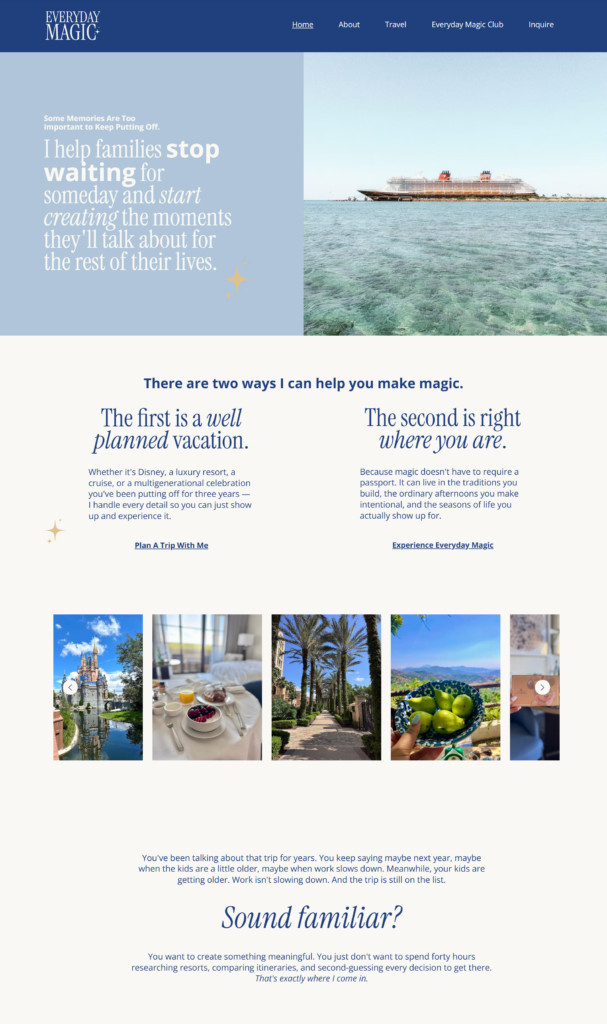
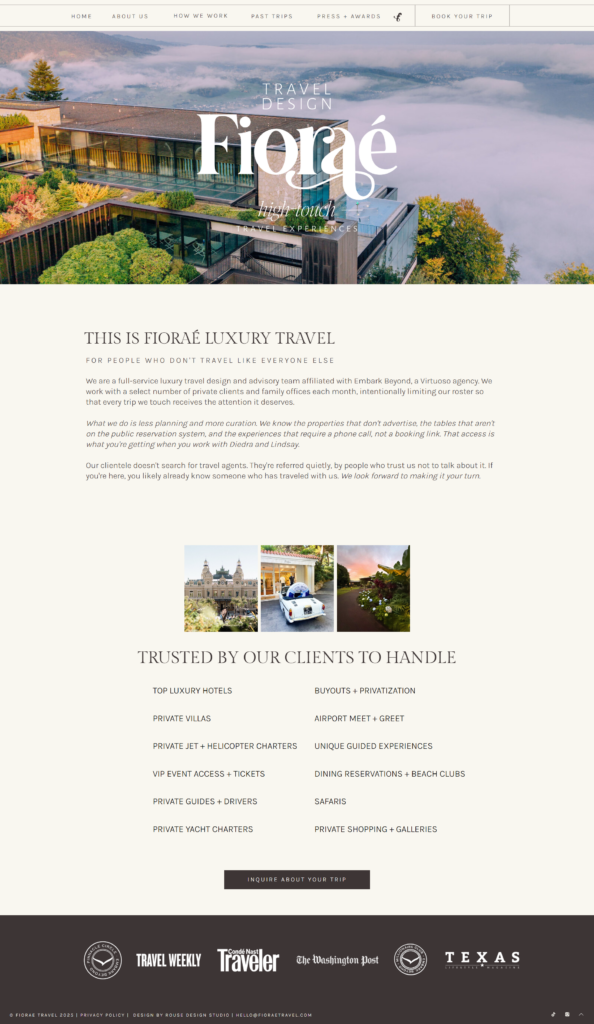
Notice the aesthetic, the copy, the language, the tone, the imagery, the font and color choices, EVERYTHING here is different!
Your website is doing more work than you think
For most agents, the website isn’t where bookings happen. It’s where trust happens.
We talk ALL about this in this travel agent specific podcast episode “Building a Bulletproof Business Part 2: Brand & Website | Why your branding isn’t converting and how to fix it with Sydney from Rouse Design Studio” with Caitlin Mendoza of Club Momenteers.
Here’s the typical path: someone finds you through a referral, an Instagram reel, a Facebook group recommendation. Then they go to your website to decide something important: is this person legit, do they actually specialize in what I need, can I picture working with them on something this personal.
If your site is vague, generic, or looks like every other agent’s site, with the same stock beach photos and the same “let us help you plan your dream vacation” copy, you lose that moment. The visitor can’t tell you apart from the dozens of other agents they could have found instead.
A simple site with sharp, specific copy beats a flashy site with generic copy every time. It doesn’t need five pages and elaborate animations. It needs to clearly say: this is who I help, this is how I help them, and this is why I’m the right person to help YOU. Real photos (even simple ones) of you, your past clients’ trips, or the experiences you specialize in do more than any stock photo ever could.
If you need help getting started on the site, I have a free link-in-bio page here you can use as your landing page on Showit!
A strong brand also protects your pricing
This one connects directly to a money conversation a lot of agents avoid: charging a planning fee. Plenty of agents are afraid that asking for a fee will scare off clients, so they skip it entirely and end up doing hours of unpaid work for people who were never serious in the first place.
Here’s the thing: a polished, specific brand and website make that fee feel obvious. When your site clearly positions you as the expert in something specific, a $100-300 planning fee reads as “of course, that’s what an expert charges.” When your site looks like every other generic agency, that same fee feels like a tough sell, because nothing about your presence has shown the client why you’re worth it.
Your brand isn’t just about attracting the right clients. It’s also what makes it possible to charge what you’re worth without flinching.
Don’t wait until you’re “big enough”
A lot of agents tell themselves they’ll invest in brand and web once they have more clients, once business picks up, once it feels worth it. But it tends to work the other way around.
The agents who invest early in sounding and looking like the expert they already are tend to get taken seriously faster. That means better clients earlier, bigger bookings sooner, and referrals that actually match their niche from the start. Waiting often just means more time spent attracting the wrong kind of client, the price shoppers, the people who don’t value the planning and expertise you bring, the ones who were never going to be a good fit anyway.
Your brand and website aren’t a reward for reaching a certain size. They’re part of how you get there.
Growth is normal, and a solid foundation makes it easier
One thing worth saying clearly: your brand and website aren’t supposed to be “done” forever. As your business grows, your understanding of who you are and who you serve gets sharper too, and your brand should evolve right alongside it.
Take one of my clients, Fioraé Luxury Travel. We’ve refreshed their website three times, and each version represented a real shift in where they were as a business. The first build gave them a strong, professional foundation. The second version pulled things into a more neutral, polished direction to start attracting the right caliber of client and let real brand and trip photography do more of the talking. Now we’re simplifying again, dialing everything up to feel unmistakably luxe, because their ideal client today is the six-figure traveler who expects that from the first scroll – who actually doesn’t even have time to scroll, they just want someone to plan their trip for them, yesterday.
None of those refreshes were a “start over.” Each one built on the last. The foundation was solid from day one, so every update was a refinement, not a rebuild.
That’s the real takeaway: you don’t have to get it perfect right out of the gate, but you do need a real foundation, not just a placeholder site. If your brand and website are built with intention from the start, even simply, you’ll be in Fioraé’s position: refining and leveling up as you grow, instead of scrapping everything and starting from zero every time your business changes.
Consistency is what builds the “expert” reputation
In travel, especially within a specialty like Disney, people are doing their research before they ever reach out. They’re cross-referencing your Instagram, your website, your Facebook group, maybe pulling up reviews. They’re piecing together an impression of who you are before you’ve said a word.
If your voice and visuals feel different across all of those, casual and silly on Instagram, stiff and corporate on your website, something else entirely in your Facebook group, it creates a subtle disconnect. A “wait, is this the same person?” feeling that, even if the visitor can’t quite articulate it, makes them hesitate.
Staying consistent in tone, in visuals, in how you talk about your specialty across every platform, makes you feel established and trustworthy, even if you only started last month. Consistency is one of the fastest ways to look like you know exactly what you’re doing, because it shows you do.
Let’s also quickly talk about SYSTEMS
Before I stop yapping, I think it’s worth talking about the systems running behind the scenes, because the right ones save you hours every week and make your clients feel like they’re in good hands.
A good system does a few things for you: it keeps every client’s preferences, trip details, and communication history in one place so nothing falls through the cracks, it automates the repetitive stuff (follow-ups, reminders, payment due dates) so you’re not manually tracking every deadline, and it gives your clients a polished, professional experience even if you’re a one-person show.
There are travel-specific options built exactly for this. Travefy is built specifically for travel advisors, with CRM functionality alongside itinerary building, client proposals, and integrations with tools you already use like Gmail. It also offers a client-facing app where travelers can view their itineraries. For agents who want broader, more customizable platforms, HubSpot CRM is a scalable option that centralizes contact management, automates marketing, and tracks customer interactions across channels.
Don’t be fooled by good marketing though!! The fanciest system isn’t always the right system. Some agents thrive with full automation, branded client portals, dashboards, the works. If that’s how your brain works, lean into it. But other agents do their best work with something as simple as a shared Google Doc or a basic spreadsheet, and that’s not a failure, that’s just knowing yourself.
Before you pick a system, ask yourself: how do I actually keep up with things day-to-day? Do I think in lists, calendars, or visual boards? Am I someone who’ll actually log into a dashboard every day, or will it sit there unused while I default to email? And just as important: what makes the experience feel smooth and professional for my client, even if the backend is simple?
The best system isn’t the one with the most features. It’s the one you’ll actually use consistently, and that makes your clients feel taken care of without adding more to your plate.
Here’s a quick overview of all the platforms you may want to look into 😅
Email marketing Flodesk (my choice), Mailerlite, or ConvertKit for newsletters, drip sequences, and client communication that feels branded rather than generic.
Social media Instagram is essentially non-negotiable for travel. TikTok is increasingly important for reach, especially with Reels content doing double duty across both. Pinterest can also be a sleeper for travel inspiration content.
Website Showit, Squarespace, or Wix, something that feels like you, not a template everyone recognizes. However, if you do want to do the template route, I have a Hot Seat VIP Day Service in which I will customize the purchased template for you.
CRM / client management This is the big one and where most agents land in one of two camps:
- Travel-specific: Travefy (itinerary building, client proposals, client-facing app), or host-agency-provided CRMs if your host has one
- General-purpose: HubSpot, Dubsado, or HoneyBook for contracts, invoicing, and client communication in one place
Booking and supplier tools Whatever your host agency requires (often non-negotiable), plus any direct supplier portals (Disney’s travel agent portal, cruise line portals, etc.)
Project/task management Notion, Trello, Asana, or even a simple Google Sheet, this is your internal “what’s happening with each client and trip” dashboard
Proposals and itineraries Travefy, Canva (for a more DIY visual approach), or built into your CRM if it has this feature
Content planning Later, Planoly, or Metricool for scheduling social posts; a simple content calendar (Notion, Google Sheets, Trello) for planning ahead
Payments and invoicing Often built into your CRM (HoneyBook, Dubsado) or handled through your host agency, but worth confirming where payments and commission tracking live
File storage and document sharing Google Drive or Dropbox for contracts, client documents, trip files
The honest advice: you don’t need all of these on day one, and you definitely don’t need the fanciest version of each. Pick one tool per category, prioritize the ones that touch your clients directly (CRM, proposals, communication), and build out from there as you grow.
Finally, yes you need your own brand photoshoot. That’s just that on that.

Hi, I'm Sydney. The problem solving brand and website designer!


