

Hello! I'm
Your hype girl, sounding board, designer, and friend! I design branding and websites for business owners who want to pave the way in their industry.
Sydney.
brand and web design services
I design brands that release the confidence in you.
made for mothers x dfw
I lead the local DFW chapter for a CEO Mom Community, MFM

Here’s a sentence I hear more than almost any other from people about to start their own thing: “I think I need a website.”
You probably do. But not yet, and definitely not the way you’re picturing it.
I asked 4 therapists who recently started their own practice and I am so excited to share their insights, alongside mine, with you!



I’ve worked with enough new business owners (therapists, travel agents, wellness practitioners, you name it) to know that “I need a website” is almost always standing in for a bigger, scarier question: “How do I make this feel real, and how do I make people trust me?” A website is part of that answer, but it’s the last part, not the first.
So let’s slow down. If I were sitting across from you with a coffee, helping you map out the first few months of your solo therapy practice, here’s where I’d start.
Step one: the boring stuff that has to happen first
Before we talk about anything pretty, we have to talk about the unglamorous backbone of your practice. Malpractice insurance. An LLC or PLLC, if your state requires it for licensed clinicians. A business bank account so your practice income isn’t tangled up with your personal grocery budget. And an EHR or practice management system (SimplePractice and TherapyNotes are the two I hear most) to handle scheduling, notes, and billing.
None of this is fun. All of it is necessary. Think of it like pouring a foundation before you start picking out paint colors. You can’t skip it, and you definitely can’t go back and “add it later” without a headache.
Step two: figure out who you’re actually talking to
This is the part where I usually see people get stuck, and it’s also the part that changes everything else.
“I help anyone with anything” feels safe. It feels like you’re not turning away potential clients. But it’s actually the hardest position to market from, because when your message has to apply to everyone, it ends up landing with no one in particular.
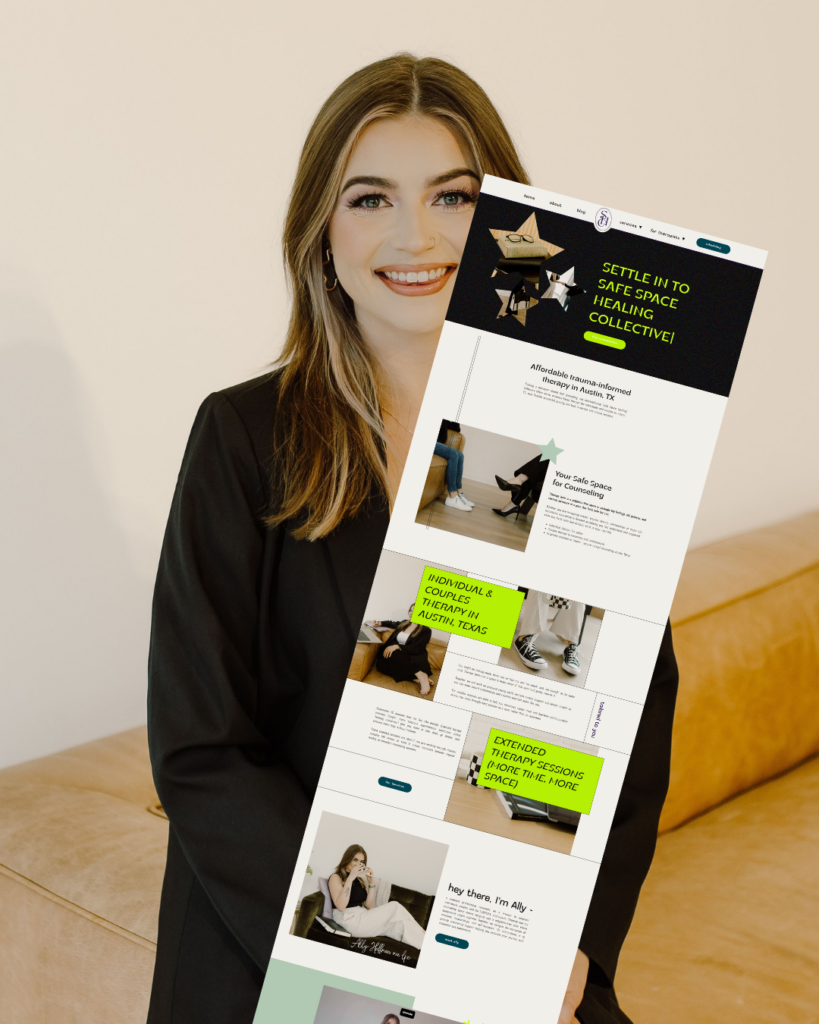
I have a friend, Ally Hoffman, who runs Safe Space Healing Collective. When I asked her what she’d tell a therapist starting their own practice, her answer was immediate: niche down, know your market, and be confident in your style. Not “eventually.” Not “once you’re established.” From the start. Lucky for you, you probably already spent 3,000 hours working with clients and noticing which ones you like and don’t like to support.
The therapists I’ve watched grow the fastest are the ones who picked a lane early. Maybe it’s birth trauma. Maybe it’s high-achieving women with anxiety. Maybe it’s couples navigating a major life transition. When you know exactly who you’re talking to, everything downstream gets easier. Your website copy practically writes itself, because you’re not trying to speak to everyone, you’re speaking to one specific person with one specific set of fears and hopes. Your Psychology Today profile gets sharper. Referrals start finding you, because another therapist or a primary care doctor can say “oh, you need to talk to her, she specializes in exactly that,” instead of just “I know a therapist.”
Step three: let your brand sound like you, not like a template
Here’s where I come in, professionally speaking. But I promise this isn’t a sales pitch, it’s just true: your brand is not your logo. It’s not your color palette. It’s the sense someone gets, within seconds, of who you are and whether they can trust you with something this personal.
My friend Reagan Kelly, who owns Althea Grace Counseling, said something that stuck with me. She talked about being clear on what makes you, you, and what presence or style you bring into the room. Because at the end of the day, you’re advertising yourself to your ideal client. Not a generic version of “a therapist.” You.
A therapist specializing in birth trauma should sound different from one specializing in executive burnout. If you’re warm and a little informal, your website shouldn’t sound like a hospital pamphlet. If you’re more structured and clinical in your approach, your site shouldn’t be all soft pastels and “hey friend!” language that doesn’t match how you actually show up in session. Please don’t catfish people!
(If you need helping figuring out how to make YOUR voice sound like your BRAND’s voice – Check out my free Sound Like You Online Workshop)
This is the part that takes the most self-reflection, and it’s the part most people rush through. Don’t. It’s the foundation everything else gets built on.
Step four: the money conversation nobody wants to have
Will you take insurance, or run private-pay only? Insurance can bring clients faster, but it comes with credentialing delays (often 60 to 90 days) and lower reimbursement rates. Private-pay gives you more control over your schedule and your rates, but it means your marketing has to work harder to convey value.
There’s no universally right answer here. But whichever direction you go, decide on purpose, not by default. And whatever you decide, set your policies before day one: cancellation policy, fees, session length, how you handle emergencies between sessions. Write it down. Future-you will thank present-you when a tricky situation comes up and you’re not improvising on the spot.
Step five: your website is your first session, sort of
Okay. Now we can talk about the website.
For most new therapists, the website isn’t where bookings happen directly. It’s where trust happens. Someone finds you, maybe through a referral, maybe through your Psychology Today profile, and before they ever send that first message, they go to your site to answer a quiet, anxious question: is this person safe? Is this person for me? Do they get what I’m going through?
If your site is vague (stock photos of someone journaling on a couch, copy that says “I help with anxiety, depression, relationships, and more”), that question gets harder to answer, and a lot of people will quietly click away rather than risk reaching out to the wrong person. That’s the real cost of a generic site. Not “it looks unprofessional.” It’s “it cost you a client who needed you specifically, and didn’t realize it.”
A simple, one-page site with sharp, specific copy will outperform a flashy five-page site with vague copy every single time. You don’t need elaborate animations. You need: this is who I help, this is how I help them, and this is why I’m the right person for YOU, said in a voice that sounds like you.
And please, don’t skip the strategy to save time. A site built without clarity on your niche, your voice, your ideal client, and a clear path to the call to action, usually needs a full redo within a year. That’s not a hypothetical, that’s just what happens. It ends up costing more time and money than getting it right (even simply) from the beginning.
Step six: marketing doesn’t have to be a second job
This is the part I think people stress about the most, and it’s the part my friend Caroline Neshyba, who runs Lions Ear Mental Health, talks about so well.
Caroline’s approach is to think in terms of a week-at-a-glance. Block your session hours, obviously, but also intentionally carve out time, maybe 30 minutes to an hour here and there, for the things that keep your practice healthy. That might mean researching something for a specific client, responding to emails, engaging in a professional Facebook group, or working on a blog post. It’s not about filling every minute of your day. It’s about protecting that small, non-negotiable chunk of time so the “behind the scenes” work doesn’t quietly pile up until it becomes a crisis.
And on the topic of marketing specifically, Ashley summarized it best – it’s okay to take the pressure off. You don’t have to post every day. You don’t have to write a blog post every week. Be clear about who you’re for and what your website and marketing communicate, and then do what you can, when you can. You can absolutely build a full practice while easing into the marketing side slowly. You don’t have to jump in the deep end on day one.
Annnd this seems like a good place to plug my Consistency is Key service – unlimited monthly access to me for past brand and/or web clients where you send me your honeydo list of marketing related tasks that have been bogging you down, and I take care of them within 48 hours! This ensures everything you put out is on brand, designed well, and feels professional. No more quick canva templates “just to get the word out real quick”. Work with me to get access!
Step seven: consistency builds the “this person knows what they’re doing” feeling
People considering therapy are often doing a lot of quiet research before they ever send that first message. They might look at your website, then your Psychology Today profile, then maybe a Facebook group where you’re active, then back to your website again. They’re piecing together an impression of you.
If your tone shifts dramatically (warm and casual in one place, stiff and clinical in another), it creates a subtle “wait, is this the same person?” feeling. Even if they can’t name it, it makes them hesitate. Staying consistent in your tone, your visuals, and how you talk about your specialty across every platform does a lot of quiet trust-building, even before you ever speak to someone.
This is why the foundation work we talked about at the beginning is so important. So there’s no room for shiny objects or someone else’s voice influence to creep in.
Step eight: have realistic expectations, and be kind to yourself
I’ll leave you with this, because I think it matters as much as anything else on this list. Reagan said it best: starting your own practice is hard, but so fulfilling.
It’s true. The first few months (sometimes the first year) can feel slower than you hoped. Referrals take time to build. Your website might need small tweaks as you learn more about who you actually serve best in practice, versus who you thought you’d serve on paper. That’s not failure. That’s just what growth looks like.
Build your foundation with intention. Niche down. Let your brand sound like you. Build a simple, strategic website instead of rushing toward a big one. Protect a little time each week for the behind-the-scenes work. And then give yourself permission to grow into the practice you’re building, one season at a time.
You don’t have to have it all figured out before you start. You just need a real foundation to start from. The rest, you’ll figure out as you go, and that’s exactly how it’s supposed to work.

Hi, I'm Sydney. The problem solving brand and website designer!


