

Hello! I'm
Your hype girl, sounding board, designer, and friend! I design branding and websites for business owners who want to pave the way in their industry.
Sydney.
brand and web design services
I design brands that release the confidence in you.
made for mothers x dfw
I lead the local DFW chapter for a CEO Mom Community, MFM

Let’s be honest — most of us have days when we feel so busy but can’t actually pinpoint what, if anything, we truly accomplished. You might’ve spent hours updating your Notion dashboard, reorganizing your Dropbox folders, or tweaking your client gift boxes for the third time this quarter. It all looked productive on the surface. But at the end of the day, your business didn’t move forward, your visibility didn’t grow, and your email inbox didn’t ding with a new inquiry.
Those are what I call spiral tasks — the ones that feel like progress but don’t actually push the needle forward in your business. They pull you into an endless swirl of activity that ends right where it began.
What Are Spiral Tasks?
Spiral tasks consume your energy and time without producing measurable results. They’re easy to fall into because they look productive. You’re doing something — clicking, tweaking, adjusting — and you can even convince yourself you’re setting things up for “when you have more time.” But truthfully, these tasks exist in the comfort zone of busyness.
Here are some common examples:
- Creating a new Notion page to organize your content ideas (when the old one works fine).
- Redesigning your client gift boxes or packaging for the fourth time.
- Rearranging photos, renaming folders, or tweaking your brand colors just a little more.
- Redesigning your website headers because “it could look cleaner.”
- Spending hours researching which productivity app will make you more productive — instead of just doing the work.
The problem with spiral tasks is they give you the satisfaction of being “in action” without producing progress. You’re circling around your business, not steering it forward.
Spiral tasks also tend to appear when we’re avoiding something bigger — like putting ourselves out there, asking for what we want, or doing the work that actually stretches us. They’re a safe distraction masquerading as work.
What Are Needle-Moving Tasks?
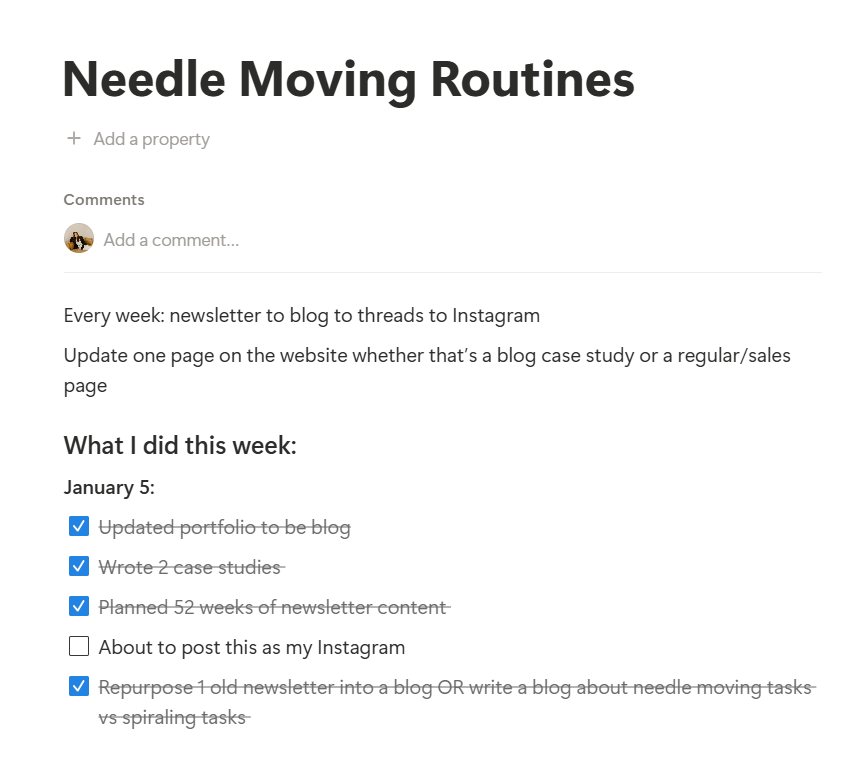
In contrast, needle-moving tasks are the actions that strengthen your visibility, build your authority, or directly connect you to clients. They can feel like busy work too — but here’s the difference: every one of these tasks is strategically tied to growth.
Examples of needle-moving tasks include:
- Writing a blog post that adds to your SEO footprint.
- Creating value-driven content for social media.
- Brainstorming newsletter ideas that nurture your audience.
- Updating your services page to better convert inquiries.
- Refreshing your links page or portfolio to reflect your best work.
- Reaching out to a past client with a personalized check-in.
- Pitching a podcast, publication, or collaboration.
The trick is that sometimes these tasks don’t have immediate results. You might post a few reels or send out a newsletter and not see new clients instantly. But these efforts compound over time — building awareness, trust, and momentum.
Needle-moving tasks keep your business in motion even when you’re not actively pushing.
Why You Need to Focus on Needle-Moving Tasks
If your energy is finite (and let’s be real, it is), you want to spend it on what actually matters. Focusing on needle-moving tasks helps you:
- Make measurable progress. You’ll see tangible results like inquiries, sales, engagement, or growth in reach.
- Stay aligned with your goals. Every task connects back to your broader objective instead of scattering your efforts.
- Break the overwhelm cycle. When you see progress from your focused work, it’s easier to stay motivated and avoid burnout.
- Reclaim time. You’ll stop wasting hours in the spiral-zone and start creating space for creativity, rest, and strategy.
When you choose needle-moving tasks over spiral ones, you stop confusing motion with momentum.
How to Plan a “Rouse Day” (or Your Own CEO Day)
One of the best ways to make sure you’re nurturing your own business (not just your clients’) is to designate a dedicated CEO day — or as I like to call mine, a Rouse Day.
A Rouse Day is time set aside each week to “rouse” your business — wake it up, energize it, and move it forward. The goal is to create momentum on tasks that advance your visibility, systems, and overall business health.
Here’s how to plan yours:
- Pick your day and protect it. Choose a consistent day of the week that you can reserve for yourself. For me, it’s Wednesdays. This day belongs to my business — not my clients’.
- Block your calendar intentionally. I have a “connection or learning block” on Wednesdays too since the community I’m part of for entrepreneurial moms usually holds mastermind calls mid-day. That activity fuels my growth — so it fits right in with my Rouse Day rhythm.
- Keep a separate list for Rouse Day tasks. Instead of stuffing your client task list with personal-business to-dos you’ll just keep pushing down, give them their own home. You’ll feel relief knowing they have a place to land and a day they’ll actually happen.
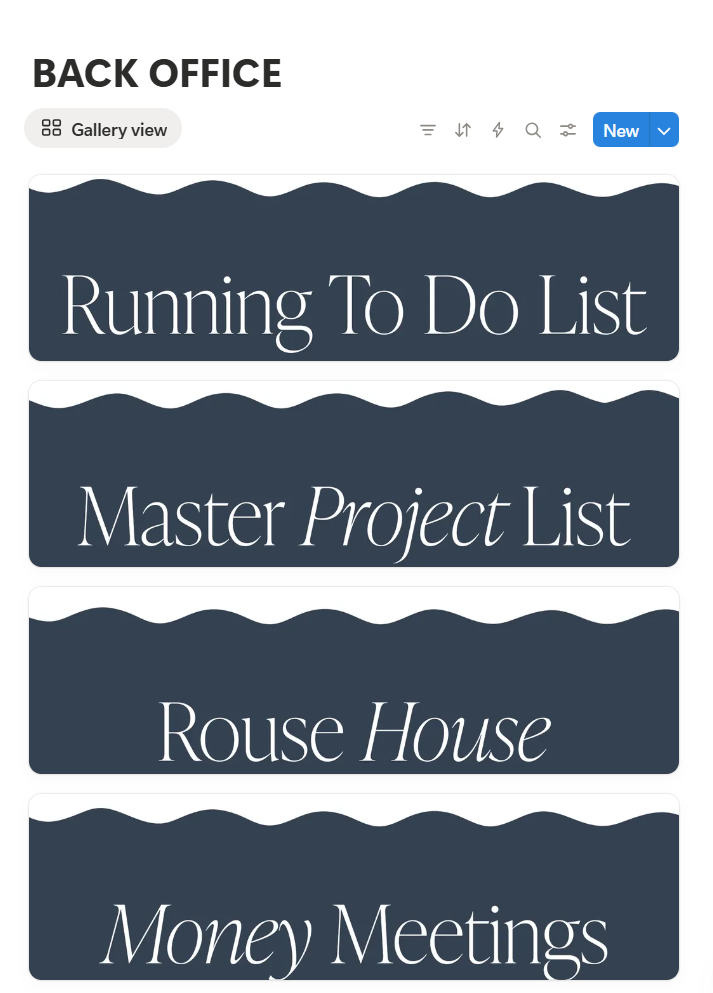
Your Rouse Day list might include things like:
- Planning your next month of marketing content.
- Writing a blog post or pinning it on Pinterest.
- Reviewing your client experience process.
- Going through analytics and tracking conversions.
- Exploring a new learning opportunity (workshop, course, community call).
- Updating your systems or templates to save time later.
When you intentionally separate your business tasks from your client work, you start treating your business with the same care and structure you give to others — and that’s where growth happens.
Tracking Your Progress: “What Did I Do for My Business This Week?”
One of my favorite mindset-shifting practices is to keep a running list titled “What I accomplished for MY business this week.”
Here’s how it works:
- At the end of each workday, jot down one to three things you did that helped your business.
- These don’t have to be huge — maybe you posted on Instagram, updated your bio, sent an inquiry follow-up, or mapped out a new offer.
- By the end of the week, review the list. You’ll see tangible evidence of growth — however small — and that momentum encourages you to keep going.
It’s an antidote to the spiral. Instead of feeling like your days vanish into busyness, you have proof that your time meant something. This practice also helps you identify what tasks truly move the needle over time — so you can focus more on those and less on the fluff.
Finding Your Flow Between Doing and Growing
As creatives, it’s easy to get lost in the doing — maintaining, fixing, refining. But building a thriving business means balancing that with growing. Growth doesn’t come from spiraling inward on perfection; it comes from consistent, outward action — showing up, sharing your work, connecting, creating, and staying visible.
If you start protecting your Rouse Day, focus on tasks that truly move the needle, and regularly celebrate what you’ve done for your own business, you’ll begin to feel momentum again. You’ll break the cycle of busy work and start seeing real growth — not just behind the scenes, but in the world’s awareness of your business too.
So this week, ask yourself one question:
Am I spinning in the spiral — or moving the needle?

Hi, I'm Sydney. The problem solving brand and website designer!


